This Meeting Could Have Been an Email
- Sep 10, 2026 modified: Sep, 23 2026
This Meeting Could Have Been an Email
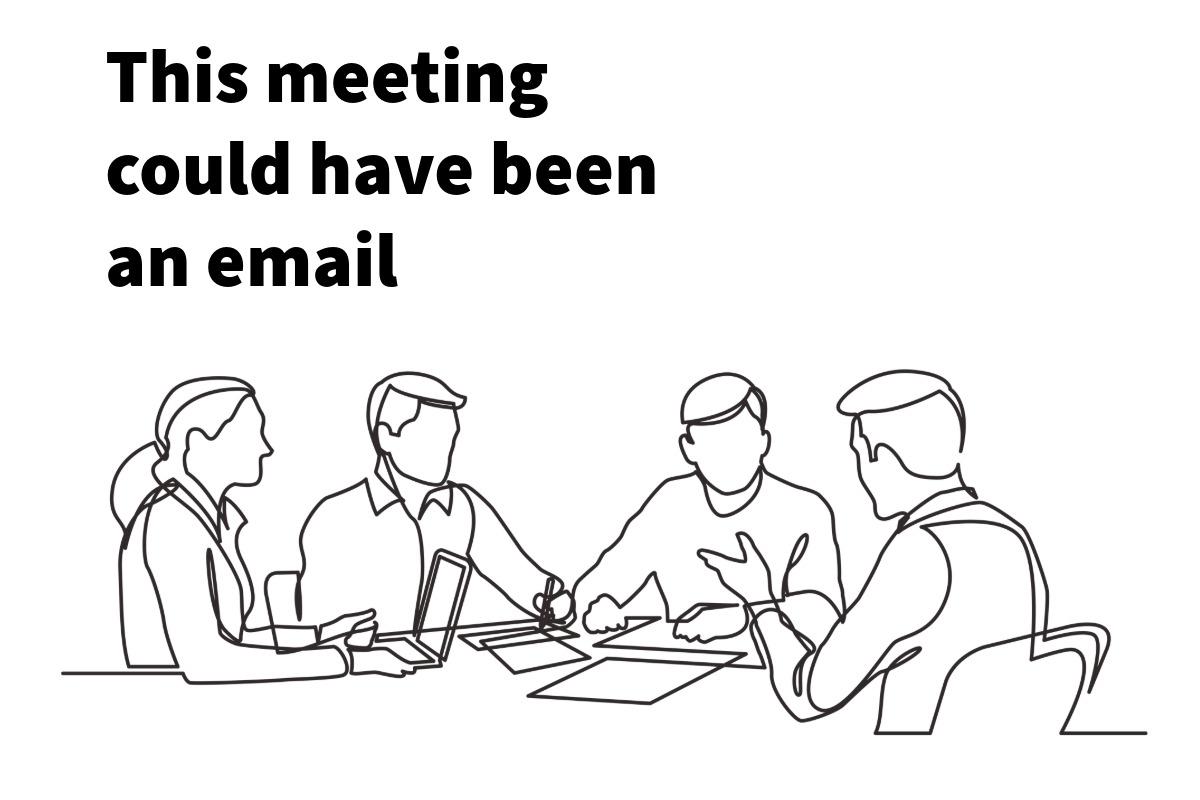
It's the line everyone thinks and almost nobody says out loud. One person talks, three people type - and by the time the calendar invite closes, nobody's quite sure what was decided that couldn't have been sorted in a two-line message. It's a small joke, but underneath it is a genuinely large number.
What Meetings Actually Cost
The frustration isn't just a feeling - researchers and workplace analysts have been measuring it for years.
$37 Billion a Year, 24 Billion Hours Wasted
Atlassian's research estimates unnecessary meetings cost U.S. businesses around $37 billion a year in salary costs alone, with roughly 24 billion hours lost annually to meetings that go nowhere.
- In a widely cited Harvard Business Review survey of 182 senior managers, 71% said their meetings were unproductive and inefficient.
- The average employee now spends close to 392 hours a year in meetings - more than 16 full working days - rating two-thirds of that time unproductive.
- Employees separately report around 31 hours a month - nearly four working days - in meetings they personally consider a waste of time.
- MIT's Center for Information Systems Research linked a 40% cut in meeting volume to a 71% lift in productivity - evidence that fewer meetings, not just better ones, is often the bigger win.
None of this means meetings are the enemy. Plenty of decisions genuinely need a room, real-time back-and-forth, or a shared screen. The problem is the meetings that exist out of habit - the recurring status update nobody re-evaluates, the "quick sync" that runs to fifty minutes, the review that's really just three people waiting their turn to speak while everyone else takes notes.
The Small Business Angle
For a small or medium business, the meeting maths is sharper because there's less slack in the system. A 2025 survey of 500 Australian small business leaders found owners already losing 8–12 hours a week to admin and interruptions outside their core work - worth somewhere between $40,000 and $90,000 a year in opportunity cost, depending on what their time is worth. Every hour spent in a meeting that could have been an email comes straight out of that same finite pool - quoting a job, following up a lead, or doing the work the business actually exists to do.
In a team of four or five, one weekly hour-long meeting isn't an hour. It's four or five hours of combined payroll time, plus the fifteen minutes on either side it takes most people to get back into focused work. Multiply that across a year and a "harmless" standing meeting can quietly cost a small business the equivalent of a full working week per employee.
One place this shows up constantly is image and design sign-off. Getting a client or a team to agree on a set of product photos, banner concepts, or layout options traditionally means booking a call just to go round the table and ask "which one do you like?" Our Adapt system was built to remove that meeting entirely - it lets us put together a collection of images and send it out as a simple emailed link, so everyone reviews and casts their vote straight from the email in their own time. The decision still gets made, just without four people clearing their calendars to make it. The Software Platform Intelligence Dividend.

A modular Java platform that adapts to any small business or community organisation — bringing enterprise capability at hosting prices.
Learn MoreHow It Works
Four steps. Minutes not hours of employee time.
1
Choose Your Audience
Select an existing collection - all subscribers, key members, or any segment you have already built.
2
Create Trackable Links
Create two short URLs - one per option. Every click is attributed to the subscriber who made it, timestamped and recorded.
3
Send the Email
Choose an existing email format and ask AI to update the content. Send to your collection in minutes - personalised per subscriber.
4
Analyse Results
One query. Exact counts. Per subscriber attribution. Timestamped. Auditable. Results in minutes - not hours of employee time.
The Volunteer and Committee Angle
Not-for-profits, sporting clubs, and community organisations feel this differently but no less sharply. Board and committee members are giving their time for free, on top of paid jobs and family commitments, so an unfocused meeting doesn't just cost productivity - it spends down the goodwill that keeps volunteers showing up at all. Sector commentary consistently points to the same warning signs of "board fatigue": agendas that barely change from one meeting to the next, papers nobody had time to read beforehand, and long discussions that circle back to where they started. For an organisation that depends entirely on people choosing to keep turning up, a meeting that runs long and resolves little is one of the fastest ways to lose them. The same email-and-vote approach works just as well here - a committee choosing between event flyer designs or venue photos doesn't need a meeting to do it, just a clear collection and a deadline to vote by. Our system has been battle tested on one of the most successful community groups in the country - for over 20 years.
Five Ways to Cut the Meetings That Don't Need to Happen
1 Give every recurring meeting an expiry date.
Review standing meetings quarterly and ask whether they're still earning their slot.
2 Require an agenda and a decision to be made.
No agenda, no meeting - a rule that alone kills a surprising number of unnecessary invites.
3 Cut the invite list to the people who decide.
Everyone else can get the outcome afterwards, in writing, in under a minute.
4 Default to 25 or 45 minutes, not 30 or 60.
Shorter defaults force sharper agendas and leave breathing room before the next call.
5 Put decisions somewhere people can respond without a meeting.
A shared page, a pinned document, or a simple emailed collection with a vote - like Image Manager v5 - beats a live meeting for anything that doesn't need real-time discussion.
Tip: before sending the invite, ask whether the outcome you need is a decision or a discussion. If it's a decision with no real disagreement expected, it's usually an email, a shared doc, or a vote. If it genuinely needs live debate or a group to align in real time, that's what meetings are for.
| Meeting Habits That Work | Meeting Habits That Waste Time |
|---|---|
| Agenda sent in advance | No agenda, "let's just jump on a call" |
| Only decision-makers invited | Whole team invited "just in case" |
| Ends with a decision and an owner | Ends with "let's take this offline" |
| Async vote or email for simple choices | A meeting booked to ask "which one do you prefer?" |
To Sum it Up
Meetings aren't the enemy - but the ones that exist purely out of habit are quietly expensive, whether that cost shows up as billable hours for a small business or burnt-out volunteers for a community group.
The fix isn't complicated: smaller invite lists, real agendas, shorter defaults, and somewhere for simple decisions to happen without a calendar invite at all.
The next time an invite goes out, it's worth asking the obvious question first. Sometimes the honest answer really is: this one could have been an email.
Sources and References
- Atlassian, cited via Speakwise, "Time Spent in Meetings Statistics 2026"
- Harvard Business Review survey, cited via Speakwise, "Unnecessary Meetings Statistics 2026"
- Notta, "Meeting Statistics" (2025/2026 data)
- MeetingToll, "57 Meeting Waste Statistics for 2026" (MIT CISR / Dery & Sebastian, 2023)
- Scalesuite, "Where SME Owners Spend Their Time" (Dext, Built for Bigger Things report, 2025)
Search News Articles...
Recent Articles

Wix Shopping Limitations
- Oct 17 2026
- /
- 155

How audio enhances SEO
- Oct 07 2026
- /
- 142

Thunderbird bounce email cleanup
- Sep 22 2026
- /
- 257

Structured Data Testing
- Sep 14 2026
- /
- 256
This Meeting Could Have Been an Email
- Sep 10 2026
- /
- 282

Where Is Your Business Data Really Stored?
- Aug 14 2026
- /
- 351

From Search to Answer Engines: The Rise of GEO
- Jul 21 2026
- /
- 445

Does Instagram Boost SEO?
- Jun 02 2026
- /
- 697

The Growing Gap Between Coding and Engineering
- May 16 2026
- /
- 716
Have AI Agents Destroyed Social Media?
- May 05 2026
- /
- 734
View All News Articles
Categories
A Gold Coast SEO and Web Developer