Keywords no longer as visible in GSC

- Jan 12, 2026 modified: Apr, 17 2026
Keywords no longer as visible in GSC
Where Did My Keywords Go? Understanding Google's Data Limits
If you've recently opened your Google Search Console (GSC) and noticed that only a handful of keywords with clicks appear in your performance report, you're not alone. Your click count (Total clicks) is not reflected in the list of queries.
Many website owners and SEO specialists have been asking the same question: Where did all the keywords go?
The truth is, Google hasn't "lost" your data.
It's simply becoming more selective about what it shows. Between new privacy filters, data truncation, and limits on how much information is stored, keyword visibility is shrinking. Add to that Google's recent update restricting third-party tools like Ahrefs to just the top 10 search results, and SEO has suddenly become a lot more complicated.
Let's unpack what's happening and what you can do about it!

The Real Reasons Why Keywords Don't Show Up in Search Console
Google Search Console remains one of the most valuable tools for understanding how people find your website. But it's far from complete. There are several technical and privacy-driven reasons why not all keywords appear in your reports.
1 Privacy Filtering
Google intentionally hides certain "long-tail" or highly unique search terms to protect users' identities. If a query is so specific that it could potentially identify an individual, it won't show up in the Search Console. This ensures user privacy but leaves you, the site owner, with incomplete data.
2 Data Truncation and Serving Limits
Google doesn't display every single query since it focuses on the most significant ones. Think of it like a highlight reel: only the top-performing data rows are stored and displayed, while the rest are filtered out to save storage and prioritize relevance.
3 Low Clicks or Impressions
If your site barely shows up for a search or receives almost no clicks, those queries might not make it to your reports. Google's system prioritizes data that demonstrates user engagement and ignores low-activity results.
4 Data Lag
If you've just updated your site or added new pages, it may take time for data to populate. Search Console data is often delayed by a few days—and for brand-new websites, it can take even longer before you see consistent metrics.
So, no, your keyword data isn't "missing." It's just being filtered, condensed, and delayed by design.
Why This Makes SEO More Challenging Today
SEO has always been part science, part art; but it's now becoming a game of interpretation.
In the past, keyword tracking tools like Ahrefs or SEMrush could scrape Google's top 100 search results for a keyword, giving SEO specialists deep visibility into ranking trends and opportunities. Ahrefs, now has a work around to the limit (launched late 2025).
That changed in 2025, when Google began restricting third-party access to only the first 10 search results. This means tools can now show you much less about your keyword landscape. You'll still get insights on high-ranking pages, but everything beyond the first page is effectively invisible.
For many marketers, this shift has been a rude awakening.
Long-tail keywords—those specific, lower-traffic terms that often convert best—are now harder to track. The result is that SEO professionals can't rely solely on keyword software anymore. They have to combine multiple data sources, analyze user behavior, and focus on what's actually working instead of what's hidden
Note only the first 10 search results now means that impression data is more accurate as it ignores scrapers that used the num=100 and actually gave a false impression (because it was a scraper not a person in many cases). There is a consensus that these impression figures have been distorted for years.
Bridging the Gap by Using Google's Search Console and Analytics Together
Here's the good news: even with Google's tighter data controls, you can still uncover meaningful insights by connecting Google Search Console (GSC) with Google Analytics (GA).
When linked, the two platforms can tell a more complete story. For example, the "Google organic search traffic: Landing page + query string" report in Google Analytics shows which pages users clicked on from organic search and how they interacted with your site afterward.
This is powerful information because it moves beyond keyword visibility and focuses on engagement. You may not see every keyword driving traffic to your page, but you can see which pages get attention, how long users stay, and whether they convert.
By analyzing this data, you can:
- Identify high-performing pages with solid engagement and optimize them further.
- Spot underperforming content that receives clicks but low interaction, signaling the need for improvement.
- Track emerging opportunities; pages that are beginning to attract traffic even if the exact queries remain hidden.
In short, combining GSC and GA gives you a more strategic view of your site's organic performance, even when keyword data is incomplete.
What "Organic Search Clicks" actually are
These numbers come from Search Console - Performance report and are imported into GA4 via the Search Console link.
They measure:
- How many times someone clicked your website in Google's organic results
- Only from Google Search (not Bing, not Yahoo)
- Only clicks on your indexed URLs
- Only when GSC is linked to GA4
GA4 itself does not track search clicks. It only displays them after pulling the data from GSC. The real bonus is to be able to identify engagement related to keywords and pages.
The New SEO Mindset: Focus on Opportunities, Not Gaps
It's easy to get frustrated with the lack of keyword transparency, but this is also a chance to rethink your approach to SEO.
The old model—chasing long lists of keywords and optimizing pages for each one—isn't sustainable anymore.
Google's evolving privacy policies and data limits are pushing SEO professionals to shift their focus from keywords to user intent.
Here's how to adapt:
- Prioritize content quality and authority. Build comprehensive, trustworthy resources that address your audience's real questions.
- Pay attention to behavior metrics. Engagement, dwell time, and conversion rates tell you far more about performance than keyword volume alone.
- Target achievable keywords. Focus on low-competition or niche topics that build your authority over time, even if they're not all visible in GSC.
- Fix technical issues. Ensure your pages are indexable, load quickly, and are mobile-friendly—because technical optimization still matters.
SEO today is about reading signals rather than raw data. Instead of worrying about what's hidden, focus on what's visible: the pages that earn clicks, the content users actually engage with, and the topics that resonate with your audience.
Chrome - Incognito mode for manual searches
To use Chrome browser in Incognito mode by click the 3 dots at the top and choose New Incognito window Ctrl+Shift+N
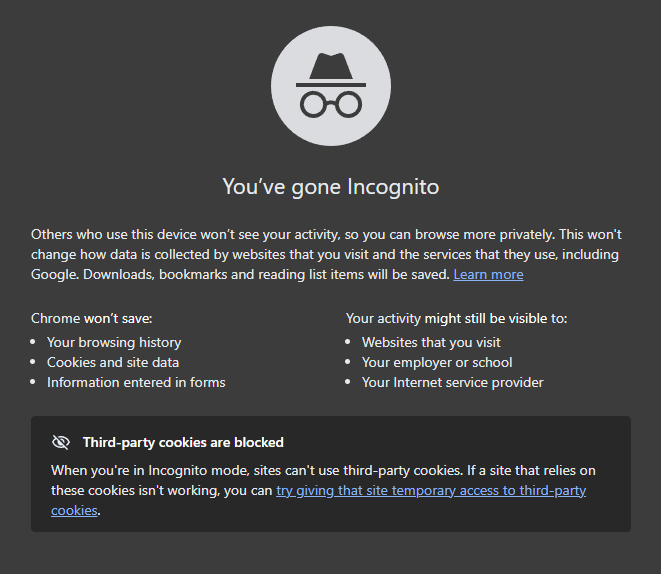
This is useful for manually finding where you rank without the influence of personalisation. SEO's do this all the time to quickly check a page. To verify what happens in a search without the influence of previous searches or being logged in.
To Conclude - Less Data, Smarter Strategy
The keyword landscape may look emptier these days, but that doesn't mean your SEO efforts are wasted. It just means the game has changed. Google's tighter data filters and SERP restrictions are forcing marketers to become smarter analysts and less dependent on keyword lists and more focused on user experience.
By learning to interpret engagement data from both Google Analytics and Search Console, you can still find the opportunities that matter most.
The missing keywords might be frustrating but in a way, they're pushing the SEO world toward what Google has wanted all along: better, more relevant, and more user-centered content.
References
Google Search Central. (2024). Understand performance data in Search Console. Retrieved from https://developers.google.com/search/blog
Ahrefs. (2024, May). Google SERP Changes: What It Means for SEO Tools. Retrieved from https://ahrefs.com/blog/google-serp-changes-update/
Google Analytics Help Center. (2024). Connect Search Console to Google Analytics. Retrieved from https://support.google.com/analytics/
Search News Articles...
Recent Articles

How audio enhances SEO
- Oct 07 2026
- /
- 56

Thunderbird bounce email cleanup
- Sep 22 2026
- /
- 161

Structured Data Testing
- Sep 14 2026
- /
- 191

This Meeting Could Have Been an Email
- Sep 10 2026
- /
- 217

Where Is Your Business Data Really Stored?
- Aug 14 2026
- /
- 301

From Search to Answer Engines: The Rise of GEO
- Jul 21 2026
- /
- 399

Does Instagram Boost SEO?
- Jun 02 2026
- /
- 644

The Growing Gap Between Coding and Engineering
- May 16 2026
- /
- 660

Have AI Agents Destroyed Social Media?
- May 05 2026
- /
- 689
Your IP Address and SEO
- Mar 06 2026
- /
- 1081
View All News Articles
Categories
A Gold Coast SEO and Web Developer